
I’m Mariko, a permaculturist living in New Zealand!
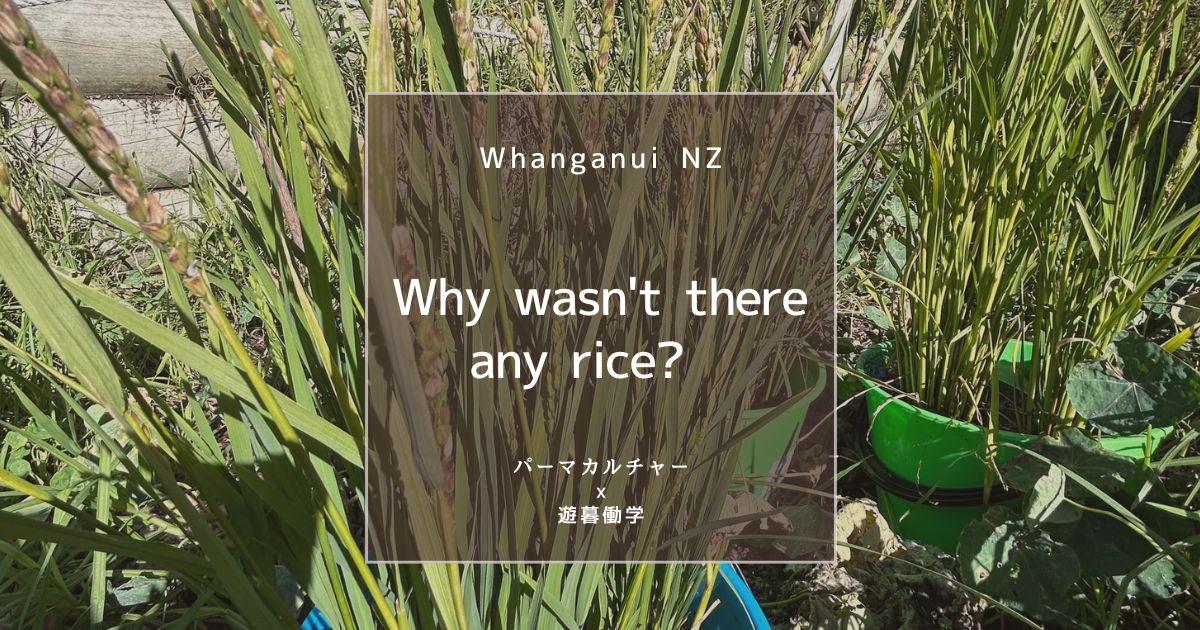
I tried growing rice in Whanganui again this year. Long story short — the grains didn’t fill in.
You can read the previous article here:

It seemed to be going well
Everything looked fine until the panicles (rice heads) came out. It was growing so easily, I almost thought it was just another grass weed.
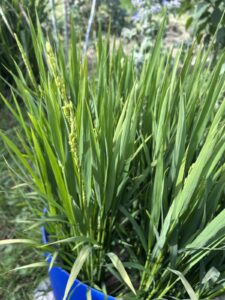
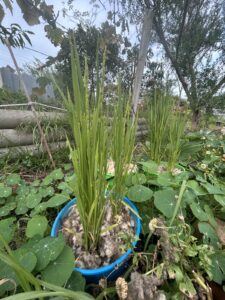
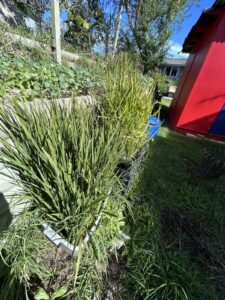
But when I came back from my trip to Japan at the end of March to early April — the end of summer here — I noticed the rice had turned brown.
Maybe it needed more nutrients?
The water level was fine.
Maybe it needed more nutrients? I tried adding what I had on hand: sheep wool with manure still attached, and chicken droppings.
Sheep and chicken manure are excellent natural organic fertilisers, rich in organic matter and containing the three key plant nutrients — nitrogen, phosphorus, and potassium.
Could it be a disease?
The plants looked healthy enough from the outside. But when I touched the grains, they were empty. And some of them had brown patches.
“Is this a disease?” I wondered, and sent photos to Claude (AI).

Low-temperature damage — most likely cause. If temperatures drop below 17°C during the heading and flowering stage, sterility occurs. Cold nights in particular can cause pollination failure.
Sterility here means the flowers bloom but can’t be pollinated, so no grain forms.
I also sent the same photos to ChatGPT, and got almost the same answer.
ChatGPT also pointed out a possible nutrient imbalance:
This happens often with bucket cultivation and natural farming. Too much nitrogen → lush leaves. Not enough potassium → empty grains. The classic ‘beautiful plant, empty grain’ pattern.
I had a lot of rice seeds, so I crammed as many as I could into each bucket. That was probably part of the problem.
A friend who has experience growing rice told me: 4 to 5 seedlings per bucket is the limit. Overcrowding and overfeeding leads to disease.
She also mentioned that leftover seeds can be stored in the fridge and used again next year.
I really should not have used all of them at once.
I also asked whether leaving the roots in might let the plant grow again next year:
If you cut it high and keep the water deep, it might become perennial — but in Japan, that only works up to the Kanto region. Too cold further north. You could try it with 2 or 3 of the healthiest buckets and see what happens.
Whanganui’s summer stays below 30°C
This season, I don’t think the temperature ever went above 30°C in Whanganui. I used the fan maybe once or twice during Summer. The nights were cold. Summer came and went without me really feeling it — as usual.
The variety I grew is called Yukihikari — a cold-tolerant variety developed in Hokkaido, Japan’s northernmost main island. But even Hokkaido’s temperatures were apparently warmer than Whanganui’s summer. Hokkaido is about the lower limit for rice to grow in Japan.
Dr. Sakurai, the original breeder of this variety, lived in Northland — a much warmer region in the north of New Zealand. Looking back, I think he chose Northland specifically because the climate suited Yukihikari.
Northland vs Whanganui
| Northland | Whanganui | |
|---|---|---|
| Summer highs | 25–30°C+ | 20–28°C |
| Night temps | Relatively warm | Can get cold |
| Wind | Sheltered in some areas | Often strong |
| Accumulated heat | Sufficient | Not enough |
Why the brown patches?
So we established that the cold prevented the grains from forming. But why did the brown patches appear?
Healthy grains, once filled, have the strength to fight off pathogens. But empty husks don’t. So common airborne fungi — like Fusarium — can move in.
…Mould? The brown patches are mould??
To me, it just looks like the empty stalks got damaged by the cold. But either way, the root cause is the same: not enough warmth.
Notes for next year
The most realistic approach is to find ways to gain a few extra degrees of warmth:
- Place buckets against a north-facing wall (the wall radiates heat and raises night temperatures)
- Cover with plastic during the heading and ripening stage
- Use black buckets to absorb more ground heat
- Start seedlings indoors earlier to bring the heading date forward
Next year: save half the seeds, plant only 4–5 seedlings per bucket.
The goal is warmth. This is all a learning process — I’ll report back next year!